Nesting cockroaches seek dark, humid microclimates where relative humidity exceeds 60%, making Middle Tennessee river valleys and shaded crawlspaces prime territory. In historic properties throughout Germantown and…
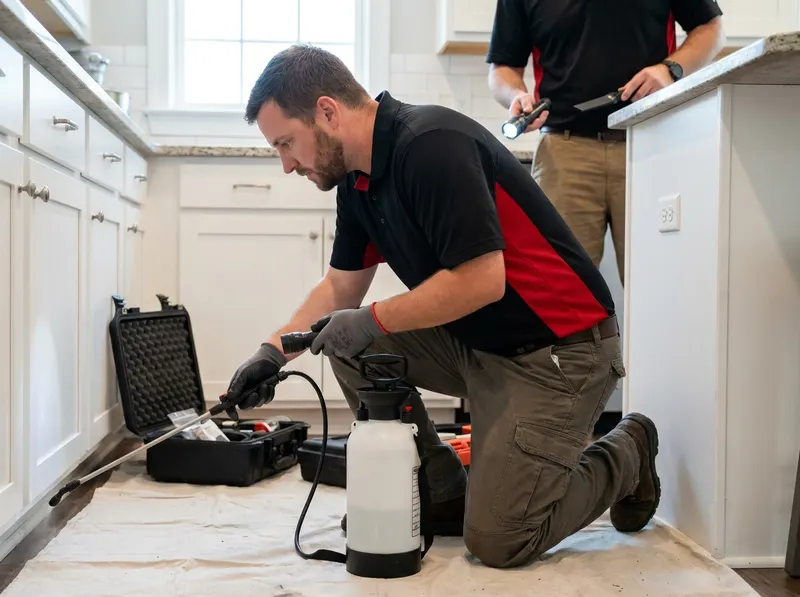
Nesting cockroaches seek dark, humid microclimates where relative humidity exceeds 60%, making Middle Tennessee river valleys and shaded crawlspaces prime territory. In historic properties throughout Germantown and East Nashville, older framing and settling foundations create interconnected wall voids where German cockroach colonies establish deep harborage behind plaster and kitchen cabinetry. Modern dwellings across The Nations, Sylvan Park, and Belmont-Hillsboro frequently harbor populations inside warm compressor compartments beneath modern dishwashers and refrigerators. Unaddressed harborages lead to allergen accumulation; the U.S. Environmental Protection Agency documents cockroach droppings, saliva, and cast skins as potent indoor triggers for childhood asthma and respiratory distress.
Eradicating these pests requires a structural, diagnostic methodology rather than superficial baseboard sprays that cause nesting females to scatter into adjoining rooms. The process begins with thermal and acoustic mapping to locate primary aggregation sites behind drywall, electrical faceplates, and crawlspace sill plates. Physical extraction using sealed HEPA vacuum equipment removes aggregate biomass, egg cases (oothecae), and pheromone-laden fecal spotting immediately. Following extraction, technicians apply structural dust formulations containing amorphous silica gel directly into dry voids, referencing guidelines established by the University of Tennessee Extension for residential insect management. Precision micro-doses of non-repellent baits and insect growth regulators (California Department of Pesticide Regulation registered IGRs) interrupt the molting cycle, rendering nymphs sterile and terminating the reproductive chain.
Moisture management plays a definitive role in preventing re-infestation, particularly in ranch-style crawlspaces in Donelson, Inglewood, and Crieve Hall, as well as heavily shaded properties near Green Hills, Radnor Lake State Park, and Shelby Bottoms Nature Center. When plumbing leaks or damp subfloors supply constant water, cockroach colonies expand exponentially. Protocols align with structural clearance standards from the U.S. Department of Housing and Urban Development Office of Lead Hazard Control and Healthy Homes and integrated pest management principles outlined by the Entomological Society of America. Applied interior bait matrices are placed inside tamper-resistant crevices out of reach of domestic pets, meeting household handling criteria monitored by the Tennessee Department of Agriculture and the Centers for Disease Control and Prevention Healthy Pets program. Service materials adhere to pesticide registration requirements verified by the National Pest Management Association and worker safety standards enforced by the Occupational Safety and Health Administration.
1. Comprehensive structural assessment inspects kitchen appliances, attic chases, and crawlspace footers to map all aggregation clusters.
2. Targeted vacuum removal physically extracts visible clusters and egg capsules to lower immediate population density.
3. Void injection applies microscopic residual desiccant dusts into structural gaps behind baseboards and electrical boxes.
4. Placement of insect growth regulators and food-attractant matrix baits ensures long-term reproductive suppression throughout hidden voids.
5. Sanitation barrier guidance identifies underlying plumbing seepage, gaps around pipe penetrations, and crawlspace humidity issues to ensure durable perimeter defense.
Every job gets a firm, written price after a free on-site visit.
Tell us about your cockroach harborage eradication job in Nashville and we'll send a clear, written quote, usually the same day.
 IronMeadow Pest Relief