Crawlspace moisture remediation in Nashville resolves the underlying dampness that attracts wood-destroying organisms to residential foundations across Middle Tennessee. Unconditioned foundation cavities beneath homes…
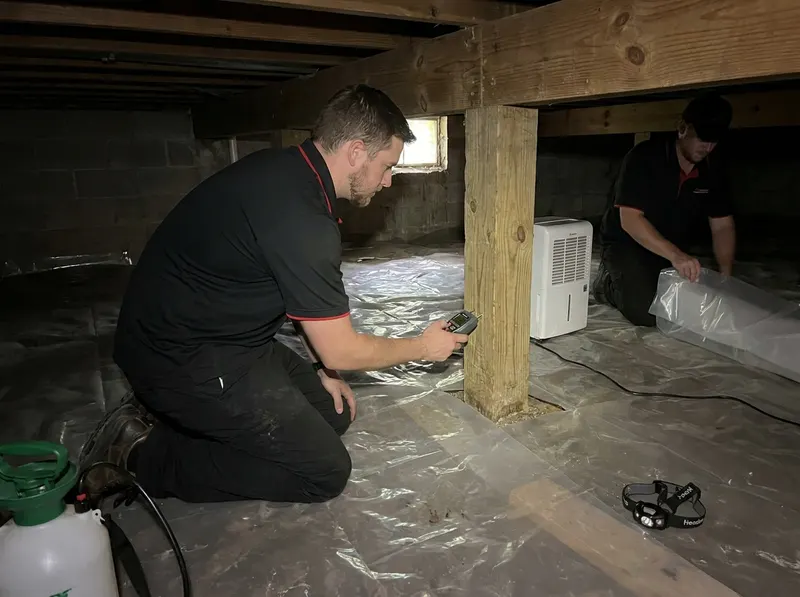
Crawlspace moisture remediation in Nashville resolves the underlying dampness that attracts wood-destroying organisms to residential foundations across Middle Tennessee. Unconditioned foundation cavities beneath homes in Davidson County frequently pull humid ambient air through exterior foundation vents during high dew-point summer stretches. This warm air condenses along cool subflooring, driving wood moisture content above the 20 percent threshold established by the U.S. Forest Service as the ignition line for wood-decay fungi and structural rot. Excess crawlspace humidity concurrently establishes preferred breeding habitats for subterranean termites, brown recluse spiders, and camel crickets. These insects migrate upward through plumbing penetrations and subfloor gaps, disrupting family comfort in living rooms and bedrooms. Remediating foundation moisture stabilizes indoor relative humidity and cuts off the damp environment that sustains recurring insect colonies.
Subterranean foundation dynamics vary significantly across the Nashville basin. Historic pier-and-beam properties throughout East Nashville, Germantown, and Belmont-Hillsboro frequently experience soil settlement that pools run-off beneath framing, requiring targeted grading alongside thick poly sheeting. Conversely, homes constructed over dense limestone strata near Sylvan Park, The Nations, and Green Hills experience hydrostatic groundwater pressure after heavy storms, which demands mechanical mitigation such as dedicated commercial sumps. Low-lying river bottom zones near Inglewood, Donelson, and Crieve Hall face extended ambient moisture exposure that accelerates mold proliferation on structural stringers. Field evaluations adhere to moisture measurement criteria documented by the U.S. Environmental Protection Agency, tracking lumber dampness levels with pin-probes to identify zones at risk of structural collapse before remediation begins.
Deciding between a targeted vapor barrier upgrade and complete sealed encapsulation depends on subfloor elevation and existing air infiltration. A reinforced 12-mil or 20-mil vapor barrier laid over bare ground stops soil evaporation at an economical rate, but it leaves existing masonry vents open to ambient air currents. Full closed encapsulation seals foundation vents, lines perimeter concrete block walls, and installs an energy-efficient crawlspace dehumidifier certified by ENERGY STAR to hold continuous subterranean moisture below 55 percent. Homeowners balance project expense against total air-quality isolation; an open vented repair carries lower installation overhead, whereas sealed encapsulation permanently stops stack-effect air transfer into family living spaces. Structural protocols reference baseline dampness prevention guidelines maintained by the U.S. Department of Housing and Urban Development and building science procedures published by the U.S. Department of Energy.
Technicians carry out physical remediation through clear sequential steps. 1. Debris clearing and site preparation remove organic construction scrap, dead rodent matter, and rotted fiberglass insulation that traps dampness against joists. 2. Soil grading smooths foundation trenches and directs minor surface seepage away from central load-bearing piers. 3. Wood treatment applies a non-volatile borate solution conforming to Tennessee Department of Agriculture standards to eradicate surface decay fungi and prevent wood-boring beetle re-infestation. 4. Membrane pinning lays reinforced high-density polyethylene sheeting across 100 percent of exposed soil, overlapping seams by a minimum of 12 inches and taping them with moisture-impermeable mastic. 5. Environmental calibration seals perimeter rim joists with expanding closed-cell foam and integrates mechanical drying units calibrated to recommendations from the ASTM International standards for foundation moisture control. For technical questions or on-site inspections, residents reach technicians directly at (629) 319-7828.
Every job gets a firm, written price after a free on-site visit.
Tell us about your crawlspace moisture remediation job in Nashville and we'll send a clear, written quote, usually the same day.
 IronMeadow Pest Relief